You’ve got a kid who tumbles in the hallway, the backyard, or pretty much anywhere there’s a flat surface — and you’re ready to give them something better. Two options keep coming up: an air track (an inflatable, slightly bouncy surface that looks like a long air mattress built for gymnastics) and a folding mat (also called a panel mat — thick foam panels hinged together so the whole thing folds up when you’re done). Both can work for home tumbling practice. Neither is perfect for every situation. The goal of this article is to help you figure out which one actually fits your athlete’s skill level, your available space, and your budget — without wasting money on the wrong tool.
If your gymnast is working on round-offs, back handsprings, or front tumbling passes and you want a training surface at home that doesn’t destroy their joints or your floor, read on. We’ll name the tradeoffs directly and give you a clear decision rule at the end.
| EDITOR'S PICK[VOFiTNY Inflatable Gymnastics A…](https://www.amazon.com/dp/B0BJWDBHYD?tag=greenflower20-20) | Mid-tier[FBSPORT Inflatable Air Gymnasti…](https://www.amazon.com/dp/B078815CXR?tag=greenflower20-20) | Budget pick[BalanceFrom 10x4 Feet 4-Panel F…](https://www.amazon.com/dp/B07143NVSL?tag=greenflower20-20) | |
|---|---|---|---|
| Type | Inflatable | Inflatable | Folding |
| Thickness | — | 4 in | 2 in |
| Length x Width | 10' x 3.3' | 10' x 3.3' | 10' x 4' |
| Pump Included | ✓ | ✓ | ✗ |
| Price | $199.99 | $103.99 | $102.99 |
| See on Amazon → | See on Amazon → | See on Amazon → |
What You’re Actually Buying: Surface Feel and Skill Stage
This is the variable most buyers underweight, and it’s the one that matters most.
Air Track: Forgiving Surface, Real Timing Tradeoffs
Air tracks provide a forgiving, springy surface. The inflation level is adjustable — firmer for more experienced tumblers, softer for beginners absorbing impact — and that adjustability is genuinely useful. The rebound is noticeably different from a hard floor, which is both a feature and a liability. Owners consistently report that air tracks make it easier for beginners to commit to new skills because the fear of a bad landing is reduced.
The tradeoff: that same bounciness can mask poor form. A gymnast learning a back handspring on an air track gets extra lift that won’t be there on the competition floor or even on a standard spring floor at the gym. GymnasticsHQ, in its home practice guidance published at gymnasticshq.com, notes that coaches at the club level frequently caution athletes who do all their home work on air tracks can develop timing habits that need to be corrected when they return to a firmer surface. This is a real cost that doesn’t appear on the purchase receipt.
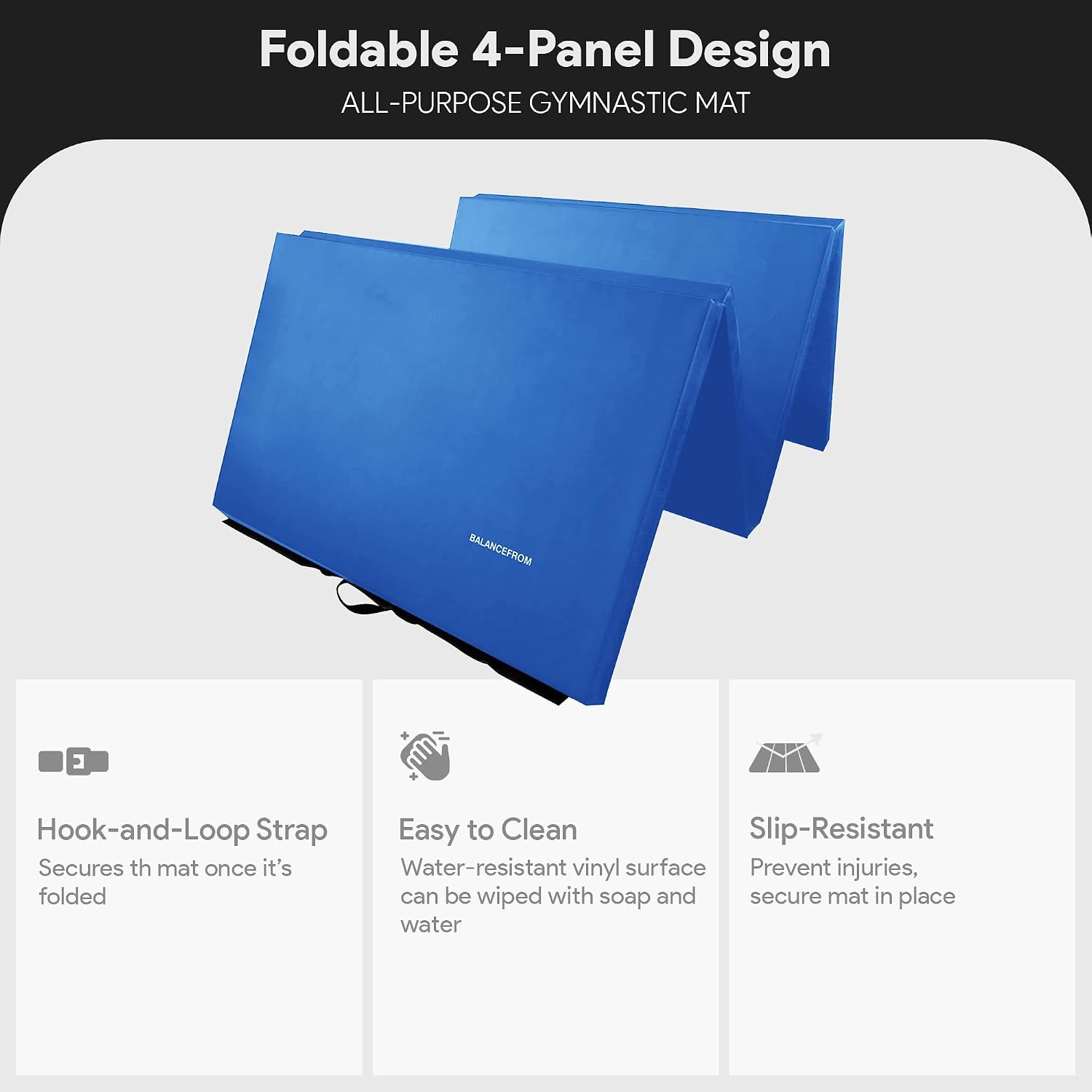
BalanceFrom
$102.99
In stock on Amazon
Check price on AmazonFolding Mat: Honest Surface, Better for Drilling
Folding mats — typically 1.5 to 2 inches thick, with a firm polyethylene foam core — behave much more like a real competition surface. There’s no rebound: what you put in is what you get out. That’s harder on the body during repetitive drilling, but it’s a more honest training analog. Owners doing conditioning work, handstand presses, cartwheel drills, and low-impact tumbling consistently report that folding mats hold their shape well over years of use and are far easier to store.
For conditioning-focused training — handstands, presses, core work, flexibility — a folding mat wins outright. There’s no skill-acquisition benefit from a springy surface for these activities, and the mat holds up better under that specific use pattern.
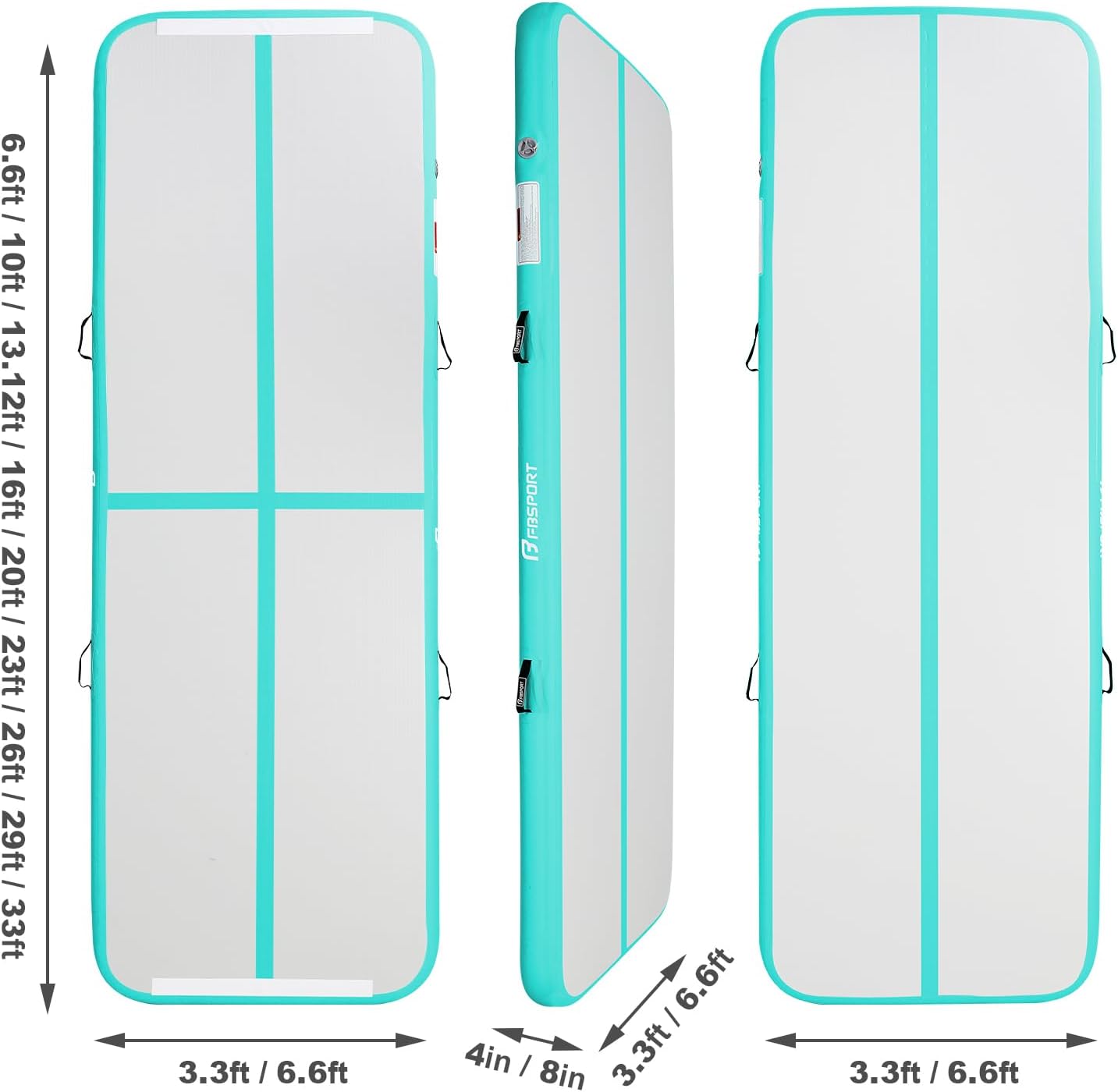
FBSPORT
$103.99
In stock on Amazon
Check price on AmazonMatching Surface to Skill Stage
The skill-stage filter is the most useful decision lens in this entire comparison:
- Intro skills (cartwheels, handstands, forward rolls): either surface works; folding mat is cheaper and more honest.
- Back handspring / round-off combos being learned: air track wins on confidence and impact absorption during the acquisition phase.
- Back handspring through layout, working toward full or double: air track risks building timing dependency; a folding mat over carpet is closer to gym-floor feel, though impact accumulates.
- Conditioning, strength drills, HS presses, flexibility: folding mat every time.
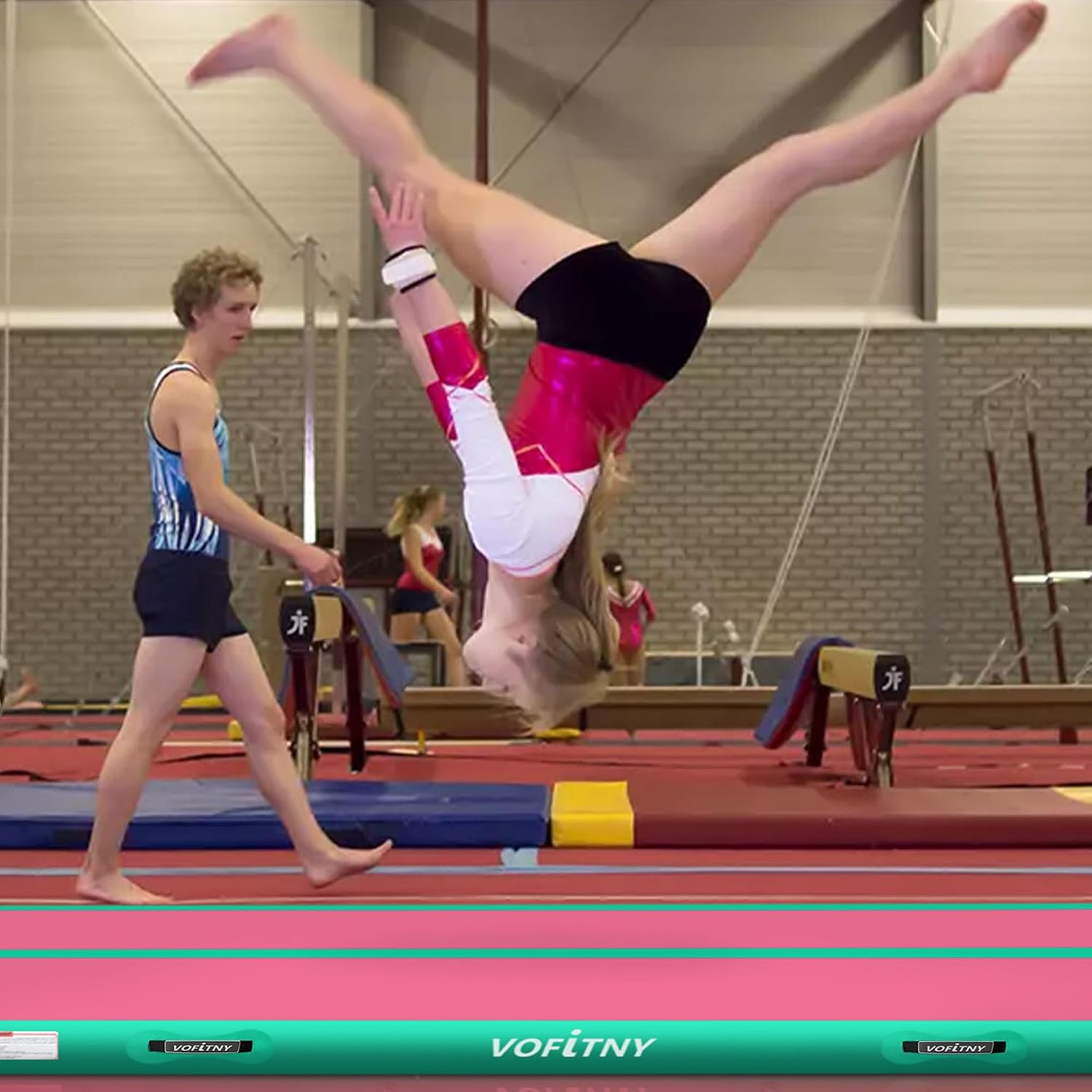
VOFiTNY
$199.99
In stock on Amazon
Check price on AmazonThe Space and Storage Math
This is where a lot of buyers get surprised.
Air tracks come in standard lengths: 10 ft, 13 ft, 16 ft, and 20 ft are the most common consumer sizes. Width is typically 3.3 ft (one meter). When inflated, a 16-foot air track needs — obviously — 16 feet of clear linear space, plus a few feet of run-up and landing buffer on each end. That’s realistically a 22–24-foot clear corridor. Backyards can handle this; most basements cannot unless you have a purpose-built rec room or an unusually wide open layout.
Deflated, an air track folds down to roughly the size of a large duffel bag. This is a genuine advantage. Storage is almost a non-issue. Inflation time using an included electric pump is typically 3–5 minutes per manufacturer specifications. Deflation and rollup takes about the same.
Folding mats are available in common sizes: 4×8 ft, 4×10 ft, and 5×10 ft are typical for home use. A 4×10 folding mat, when folded, is approximately 4×2.5 ft and about 8–10 inches thick — it stands upright in a closet or against a wall without much drama. When unfolded, a 4×10 fits in most finished basements and spare rooms with room to spare.
The critical limitation: you cannot tumble a full back handspring on a 4×10 mat. It’s not long enough for a running skill. Folding mats at home are realistically for drilling individual skills, not full passes.
Comparison by the Numbers
| Surface | Usable Length | Folded Footprint | Setup Time | Price Range (2026) |
|---|---|---|---|---|
| Air Track (16 ft) | 16 ft | ~36″ × 18″ bag | 3–5 min | $180–$380 |
| Air Track (20 ft) | 20 ft | ~42″ × 20″ bag | 4–6 min | $280–$500 |
| Folding Mat (4×8) | 8 ft | 4×2 ft, upright | Instant | $60–$130 |
| Folding Mat (4×10) | 10 ft | 4×2.5 ft, upright | Instant | $90–$180 |
Prices reflect aggregated retailer listings as of mid-2026; specialty brands such as Tumbl Trak, Z-Athletic, and Gymnastics Direct sit at the higher end of each range; off-brand imports at the lower end.
Durability, Safety Standards, and What to Watch For
Neither product category has a single governing certification the way FIG-rated apparatus does for competitive equipment. The Fédération Internationale de Gymnastique (FIG), in its apparatus norms documentation published at fig-gymnastics.com, sets shock-absorption and surface-compliance standards for sanctioned competition equipment — but those standards apply to facility-grade apparatus, not to consumer training products. That context matters for setting expectations.
USA Gymnastics’ Equipment and Facility Standards documentation, available at usagym.org, addresses safety for training surfaces in terms of shock-absorption requirements. These are written for facility-level compliance rather than for consumer products, but the underlying principles — consistent shock absorption across the surface, no dead spots, predictable rebound — are useful benchmarks when evaluating any training mat.
For air tracks: The key spec is drop-stitch construction density and PVC thickness, usually expressed in grams per square meter for the outer material. Specialty manufacturers such as Tumbl Trak publish product documentation specifying commercial-grade drop-stitch cores and reinforced PVC skins rated for sustained pressure under repeated impact. Off-brand air tracks sold via mass-market channels frequently use thinner PVC (lighter GSM ratings) that owners report developing slow leaks within 6–12 months of regular use. The electric pump matters too — a pump that cannot maintain pressure during a session is a real frustration. Look for models where the pump is included and rated to the track’s recommended PSI range.
For folding mats: The foam density — typically expressed in pounds per cubic foot — is the primary durability signal. A 1.9–2.2 lb/ft³ polyethylene foam core holds up over years of hard use; cheaper mats use lower-density foam that compresses and loses its protective quality within a season. Vinyl cover weight matters for tear resistance — 18 oz vinyl is the standard cited by specialty mat suppliers; lighter covers delaminate at the fold lines. GymnasticsHQ’s home mat buying guidance at gymnasticshq.com consistently flags foam density and cover weight as the top two specifications to confirm before purchasing.
Wirecutter’s home gym coverage at wirecutter.com notes a broader principle that applies directly here: the cheapest option in any padded-surface category almost always fails at the connection points — seams, fold hinges, and valve fittings for inflatables. That observation holds true specifically for gymnastics mats. A folding mat from a known specialty brand at $110 will outlast a $75 off-brand import by years, and the same logic applies to air tracks.
The Real Cost of Getting This Wrong
If you buy an air track and your basement is 18 feet long, you have a frustrating piece of gear that cannot be fully used and creates a trip hazard when partially inflated against a wall. If you buy a 4×8 folding mat for a kid working on back handsprings, you have a mat they’ll step off the edge of every single rep.
The opportunity cost cuts the other way too: a family that spends $350 on a 20-foot air track for a gymnast who primarily needs to drill handstands, splits, and conditioning work between practices has bought a lot of inflation device for a problem that a $90 folding mat solves better and more durably.
There is also a surface-transfer cost that doesn’t show up on a receipt. Per guidance from GymnasticsHQ and the broader club coaching community, athletes who over-rely on springy air track surfaces at home and then compete or test skills on a harder surface often experience a short but real re-adjustment period in timing and takeoff mechanics. For a gymnast in a serious club program working toward Level 6 and above, that timing lag matters. If your athlete’s gym coach has expressed concern about home surface work, a folding mat that more closely mimics the gym’s spring floor surface is the lower-risk choice.
Decision Rule: If X, Then Y
Here’s the decision frame. Apply the one that fits.
If your space is under 20 feet long → Buy a folding mat (4×10 or 5×10). You don’t have room for a full air track pass, and the mat is more versatile for the drills that actually fit your space.
If your gymnast is learning a first backward skill (back walkover, back handspring) → An air track is worth the investment. The confidence and impact absorption it provides during the acquisition phase of a scary skill has real value. Budget for a 16 ft minimum.
If your gymnast is at Level 5+ and drilling known skills between practices → A folding mat is the more honest training surface. Skills consolidated on a forgiving track can carry timing errors to competition.
If you’re conditioning-focused — handstands, presses, core work, flexibility — → Folding mat, no contest. There is no skill acquisition benefit from the air track for these activities, and the mat is more durable for that use pattern.
If your kid does recreational gymnastics and you want something the whole family can use → Air track. It is more versatile for general tumbling play and absorbs the abuse of multiple users better than a panel mat.
If budget is the binding constraint → A quality folding mat from a known specialty brand at $90–$150 will outlast a cheap air track by years and do the job for most home drill work. The air track is the right tool in specific situations — but it is not the default right answer just because it looks more exciting.
Both surfaces have their place. The mistake isn’t buying either one — it’s buying the wrong one for your actual space and your athlete’s actual training stage.