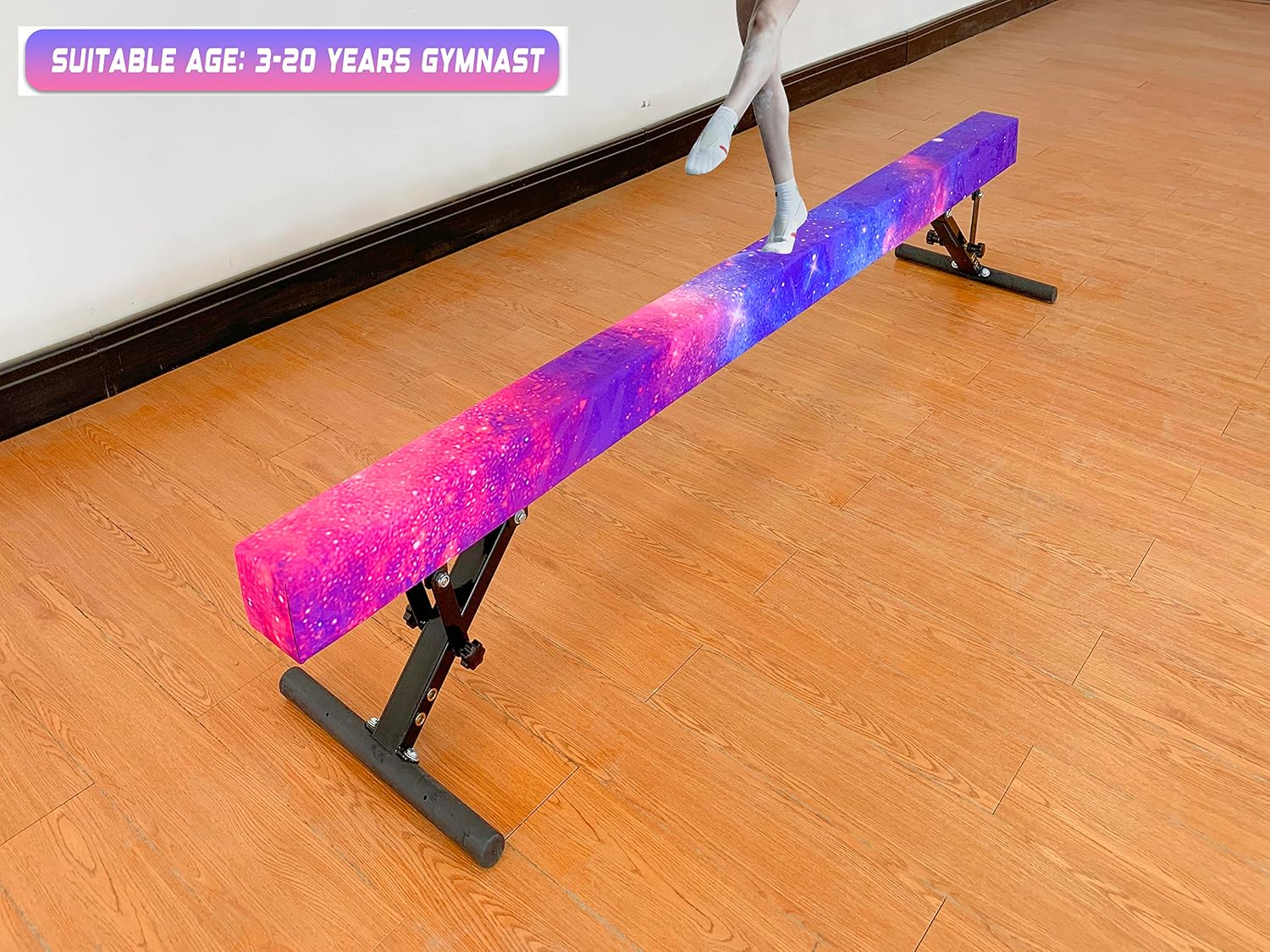
Picture this: the beam arrives on a pallet on a Tuesday morning. It’s a beautiful adjustable-height model — the kind that goes from floor level (about 4 inches off the ground, good for beginners) all the way up to full competition height (exactly 4 feet, 1.2 meters, per FIG — the Fédération Internationale de Gymnastique, gymnastics’ global governing body). You and your spouse muscle it through the garage door, peel off the packaging, and then… the ceiling fan is right there. And the mat you ordered to cushion falls won’t lie flat because the garage fridge is in the way. This article exists so that Tuesday never happens to you. We’ll walk through every dimension that matters — beam footprint, mat clearance, ceiling height, and door width — and show you the math so you can buy with confidence.
The Numbers You Need Before You Click “Add to Cart”
Most buyers focus on the beam itself. That’s the wrong starting point. The beam is a fixed object; the system — beam plus landing mats plus the gymnast in motion — is what has to fit. Here’s the full picture.
By the numbers: minimum recommended space for a home adjustable beam setup
| Dimension | Low-end setup (beam at floor level) | Full competition height (4 ft / 1.2 m) |
|---|---|---|
| Beam surface length | 16 ft 5 in (5.0 m) | 16 ft 5 in (5.0 m) |
| End-to-end footprint with leg extensions | ~17 ft 6 in (5.3 m) | ~17 ft 6 in (5.3 m) |
| Width of beam + mat coverage | 8–10 ft (2.4–3.0 m) | 8–10 ft (2.4–3.0 m) |
| Minimum ceiling clearance | 8 ft (2.4 m) | 10 ft (3.0 m) recommended; 9 ft absolute floor |
| Recommended mat depth at each end | 4–6 in foam cartwheel mat | 4-inch landing mat minimum; 8-inch preferred |
Sources: FIG Apparatus Norms (Women’s Artistic Gymnastics), Spieth America apparatus technical data, and USA Gymnastics Equipment and Facility Safety Guidelines.
The single most-overlooked number is ceiling clearance. At floor level, a gymnast doing a back walkover (a move where the body arcs fully overhead) needs roughly 7.5 feet of vertical clearance just for the body — and you need margin above that. At full competition height, add 4 more feet for the beam itself, plus 2–3 feet for a gymnast in an upright arabesque or dismount. That’s how you get to a genuine 10-foot ceiling requirement for serious training.
Footprint Reality: The Beam Doesn’t End at the Beam
The official beam surface is 5 meters (16 feet 5 inches) long and exactly 10 centimeters (about 4 inches) wide — those specs are locked by FIG and are identical across every manufacturer making a certified apparatus, from AAI to Gymnova to Spieth America. What changes between brands is the leg structure.
Leg overhang matters more than most buyers realize. Adjustable-height beams use one of two base designs: an A-frame leg (the legs splay outward from a single pivot point at each end) or a T-bar base (a flat crossbar at each end). A-frame legs on many club-grade beams extend 6–12 inches past the beam surface on each end, pushing the total floor footprint closer to 17.5–18 feet. T-bar bases tend to be more compact lengthwise but can extend 18–24 inches to each side, which matters for narrow garages.
AAI’s professional balance beam spec sheet lists a base width of approximately 39 inches (nearly a full meter) at its widest point when fully deployed. Spieth America’s comparable model runs slightly narrower. If your garage bay is 10 feet wide and you’re hoping to park a car in one side and beam in the other — run the numbers first. A 39-inch base plus 3 feet of mat on each side of the beam plus 6 inches of walk clearance means you need close to 9 feet of usable width just for the beam zone.
The mat math. GymnasticsHQ’s home gymnastics equipment overview recommends a minimum of 4-inch landing mats on all sides of a raised beam. At competition height, USA Gymnastics safety guidelines strongly recommend 8-inch mats at dismount zones (the ends of the beam and the long sides where falls occur most). A standard 4-inch folding mat is 4×8 feet. To cover both long sides and both ends, you’re looking at six to eight of those panels arranged around the beam — which adds roughly 4 feet of mat coverage in every direction and means your actual floor footprint balloons to about 10 feet wide and 25–26 feet long at full deployment.
That’s a two-car garage, not a single bay.
Ceiling Height: Where Most Home Setups Actually Fail
Standard residential garage ceiling height is 8 feet. Standard raised-door opening height on a modern two-car garage is 7 feet. Neither is adequate for a beam set above floor level, full stop.
Here’s the tradeoff matrix:
Beam at floor level (4 inches): An 8-foot ceiling works for most skills below a back walkover. Handstands, cartwheels, and basic leaps are generally fine. Anything involving a significant overhead arc is marginal. This is a reasonable setup for a Level 3–4 athlete working compulsory skills.
Beam at mid height (~24–36 inches): You’re past the safe zone for an 8-foot ceiling. A gymnast doing even a moderate leap on a 30-inch beam has her feet 30 inches off the ground and her head potentially 8–9 feet off the ground in a jump. The ceiling is right there.
Beam at full height (4 feet / 1.2 meters): USA Gymnastics safety guidelines and general facility standards cited across coaching resources consistently recommend a minimum of 9 feet of clear ceiling height, with 10–12 feet preferred for any skill that goes overhead. In a standard 8-foot garage, a beam at full height is not recommended for anything beyond static balance work — no mounts, no jumps, no walkovers.
The practical decision rule: if your garage ceiling is under 9 feet, plan to operate the beam at floor level or low-to-mid height. If you have a vaulted garage, a shop building, or a pole barn with 10–12 feet of clear height, you have real training options at raised heights.
Door clearance is a separate issue. The beam arrives in sections in most cases, but the base legs may ship assembled. Check your delivery path: a standard pre-hung interior door is 6 feet 8 inches tall; a standard single-car garage door is 7 feet. A beam base in its shipping carton can run 7–8 feet long and 18–24 inches tall. Measure your delivery path, including any turns in a hallway.
Adjustable Height Mechanisms: What Changes at the Higher End
Entry-level adjustable beams (roughly $150–$350) typically use a simple pin-and-hole height adjustment — you pull a spring pin, slide the leg to the desired hole, and re-seat the pin. These adjust in fixed increments (often 6-inch steps) and are well-suited for a gymnast moving between floor level and about 24 inches. Owners of these models in aggregated reviews consistently note they’re stable at lower heights but can develop wobble at or near maximum height if the pin-and-hole tolerances wear over time.
Club-grade and professional-grade adjustable beams in the $300–$600 range (the American Athletic or AAI professional category) typically use a threaded-bolt or locking-collar system that allows more precise incremental adjustment and holds position more rigidly at full height. Spec sheets for these models rate weight capacity from 250 to 300+ pounds, and the adjustment range is typically continuous rather than stepped.
The institutional tier — Spieth America, Gymnova, AAI Elite Series — is designed for a beam that stays set at one height for a training session rather than being adjusted kid-to-kid in a home setting. If you’re a facility director, this is your world and these units are engineered for that use case. For a home buyer, these are over-specified unless your athlete is training at a high level and you have a permanent, appropriately-dimensioned space.
If X, then Y — the decision framework:
- If your ceiling is under 9 feet: Buy a floor-level or low-adjustable beam and keep training skills that don’t require overhead clearance. Don’t spend on a full-height adjustable if you can’t safely use the top range.
- If your garage is a single-bay (10–11 feet wide): Choose a T-bar base design over an A-frame to preserve width. Confirm base width in the spec sheet before purchasing — don’t assume.
- If your gymnast is Level 5 or above training for competition: A mid-range adjustable beam ($300–$600) at a fixed height appropriate for her level, with proper mat coverage, beats a cheap adjustable at full height every time. Stability matters more than flexibility of height in that range.
- If your space has 10+ foot ceilings and a full two-car bay: You have real options. A club-grade beam at full or near-full height with proper mat coverage (8-inch mats at dismount zones) is a viable training environment — not a replacement for a club gym, but a legitimate supplement.
- If you’re a facility director spec-ing a permanent installation: The footprint and clearance math is the same, but material choice and FIG certification matter. Per the FIG Apparatus Norms document for Women’s Artistic Gymnastics, only apparatus meeting specific structural and surface specifications may be used at sanctioned competitions. Verify certification level — FIG-rated versus club-grade versus recreational — before purchasing for a competitive program.
One More Measurement You Probably Forgot
Floor flatness. Adjustable-height beams have leveling feet on most models in the $300-and-up range; cheaper models don’t. Garage floors slope — typically 1/8 to 1/4 inch per foot toward the door for drainage. On a 17-foot beam, that’s potentially 2+ inches of grade across the full length. A beam that isn’t level is a beam that rocks. Before the beam arrives, lay a 4-foot or 6-foot level across your slab in multiple directions and note the slope. If it’s significant, plan for leveling shims (thin wedges placed under the feet) or verify that the beam model you’re considering has adjustable feet with enough range to compensate.
The beam is the easy part. The space is the work. Measure everything twice, verify the spec sheet against your actual dimensions, and you’ll have a setup that earns its floor space every day.